
If you’ve ever dreamed of waking up surrounded by soaring snow-capped peaks, Hunza Valley is one of those rare places where that dream feels tangible. Perched in northern Pakistan, the valley stretches like a green jewel between jagged mountains, glaciers, and turquoise rivers. Hunza Peak View Resort sits on a perfect vantage point within this landscape.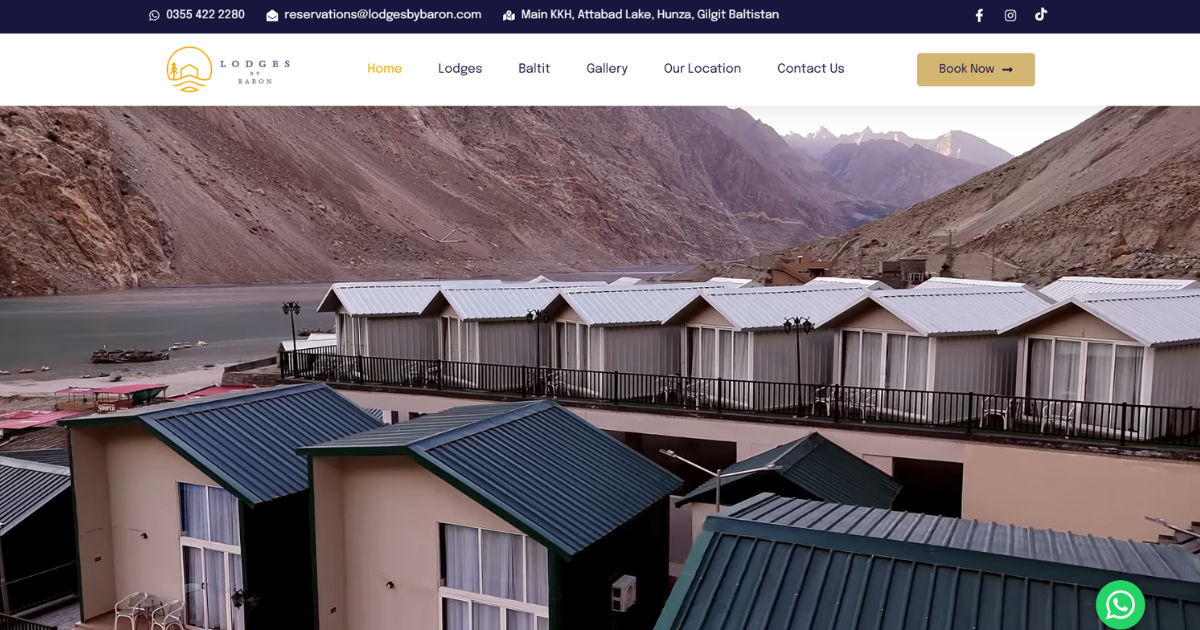
From the resort, you don’t just see mountains you feel their presence. The air carries a crispness that makes the scenery sharper, and each peak seems to tell a story of centuries-old glaciers and relentless weather.
What makes Hunza Peak View Resort and Lodges by Baron special isn’t just its accommodations or hospitality; it’s the sheer immediacy of the mountains. Many travelers pass through Hunza on their way to Karimabad or the Karakoram Highway, but if you stay here, the view is not a postcard you need to chase it’s right outside your window.
From early morning light catching snow ridges to the evening sun turning peaks golden, the resort offers a front-row seat to the grandeur of the Karakoram.
I’ve spent mornings sipping tea on the balcony while clouds swirled around the lower slopes, and evenings watching stars emerge above jagged silhouettes. For anyone who appreciates mountains, this is more than a view it’s a lived experience.
Karakoram Range Overview
The mountains visible from Hunza Peak View Resort belong largely to the Karakoram Range, one of the world’s most dramatic mountain systems. Unlike the Himalayas, which are broad and rolling in places, the Karakoram feels immediate and vertical. Peaks rise sharply, glaciers cut deep into valleys, and the landscape seems to grow more rugged with every turn. Visibility of the Karakoram is not just about location it depends heavily on weather, seasonal conditions, and even the time of day. Mist, clouds, or haze can obscure even some of the most famous peaks, so what you see is often a fleeting gift.
From the resort, the Karakoram stretches like a wall of jagged giants, each peak distinct yet part of a larger drama. Rakaposhi, Ultar Sar, and Ladyfinger Peak dominate the view, but smaller peaks and ridges add depth and texture. The interplay of sunlight, shadows, and clouds makes the panorama dynamic. One moment, the mountains are etched sharply against a deep blue sky; the next, they vanish into clouds, only to reappear as the mist shifts. Understanding the Karakoram’s patterns how storms roll in from the north, how winter snow lingers on ridges is key to actually enjoying what the eye sees from Hunza Peak View Resort. You can’t control the weather, but you can learn when and where to be ready.
Major Mountains Visible
Rakaposhi
Rakaposhi is the crown jewel of the Hunza skyline. At 7,788 meters, it is one of the highest peaks in the Karakoram, and its bulk dominates any view from the central Hunza area. From Hunza Peak View Resort, Rakaposhi looks impossibly steep yet elegant, with a long, glaciated slope that seems to reach straight into the clouds. Unlike some mountains that appear distant or inaccessible, Rakaposhi feels close from the resort. On clear mornings, you can trace the ridges from base to summit, noticing the sharp icefalls and seracs that make climbing it notoriously difficult.
In my experience, Rakaposhi is most photogenic just after sunrise, when the eastern light washes over the snow, creating a soft, golden sheen. Afternoon views can flatten the slopes slightly, but clouds often add drama in ways a calm morning can’t. If you’re keen on spotting climbing activity, the base camps and approach routes can sometimes be seen from the resort’s higher terraces, although they are tiny specks against the massive peak.
Ultar Sar
Ultar Sar is a peak that surprises most first-time visitors. At 7,388 meters, it is slightly smaller than Rakaposhi but far more rugged and jagged in profile. From Hunza Peak View Resort, Ultar Sar catches the eye with its vertical faces, knife-like ridges, and the way it seems to rise straight out of the valley floor. Unlike Rakaposhi, which commands attention with size, Ultar Sar fascinates with texture. Crevasses, rocky buttresses, and hanging glaciers make it a photographer’s dream, but also a reminder of the Karakoram’s harshness.
What most people overlook is how Ultar Sar’s visibility changes with light. Early morning, its north face may be in shadow while the southern slopes glow; late afternoon, the pattern reverses. In windy conditions, snow clouds can veil the summit, giving it a brooding, mysterious appearance. For those staying at Hunza Peak View Resort, watching Ultar Sar over multiple days reveals nuances in light, shadow, and weather you won’t notice from a single glance.
Ladyfinger Peak
Ladyfinger Peak, or Bublimating, is one of the most iconic spires in Hunza. Unlike the larger massifs around it, Ladyfinger is a narrow, needle-like formation that rises sharply to about 6,000 meters. Its thin, pointed silhouette pierces the sky, and from Hunza Peak View Resort, it almost seems within arm’s reach. This is deceptive, of course, but it’s what makes photographing Ladyfinger so thrilling you can capture its elegance against a backdrop of rugged glaciers and neighboring peaks.
In practical terms, Ladyfinger is best viewed from balconies or terraces facing the eastern side of the valley. Clouds can gather quickly around its peak, creating dramatic moments. I’ve had mornings where the tip disappeared into mist and then reappeared an hour later as if someone had drawn it with a pencil. It’s also a favorite for amateur climbers practicing technical rock climbing on nearby ridges, though the true summit is not for casual adventurers.
Hunza Peak
Hunza Peak itself is smaller compared to Rakaposhi or Ultar Sar, standing at around 6,270 meters, but its prominence comes from location rather than height. It is tucked near the village and adds a sense of scale to the valley. From the resort, Hunza Peak is usually visible in the background, partially behind ridges that create natural framing for photos. The peak is less famous internationally but holds significance locally, often used as a reference point for trekking routes and altitude acclimatization hikes.
The beauty of Hunza Peak is how it interacts with surrounding landscapes. It forms a visual bridge between the jagged giants of Rakaposhi and Ultar Sar and the more delicate spires like Ladyfinger. In my experience, seeing Hunza Peak change color in late afternoon light is one of the subtle delights of staying at Hunza Peak View Resort.
Bojohagur Duanasir
Bojohagur Duanasir, sometimes called B.D., is a peak that few casual travelers know by name, but its silhouette is unmistakable from Hunza Peak View Resort. Its jagged ridges extend like fingers across the skyline, making it visually interesting even if it isn’t among the tallest peaks. For trekkers and climbers, B.D. offers challenging routes and spectacular glacial terrain, but for visitors at the resort, it is a sculptural piece of the horizon. Watching clouds cling to its ridges in the early morning or late evening gives a sense of movement and drama to the valley view, something static photographs rarely capture.
Other Peaks Sometimes Sighted
While the major peaks dominate the view, several other mountains occasionally make an appearance. Diran, Spantik, and Passu Sar are all visible under the right conditions. Diran, at 7,266 meters, is striking for its pyramid shape, but visibility from the resort depends heavily on weather. Spantik, known as “Golden Peak” for the way sunlight reflects off its snow, can be seen during clear autumn or early spring mornings. Passu Sar, part of the famous Passu Glacier and Passu Cones, occasionally peeks from the northern horizon, but clouds or haze often obscure it. These peaks are rewards for patient observers. If the sky is clear and the light favorable, even these more distant mountains contribute to the dramatic sense of scale that makes Hunza Valley unique.
Best Times & Conditions
From my experience, the best time to enjoy unobstructed mountain views is from late March through early June, and again in September and October. During these months, the sky tends to be clearer, and the weather is generally stable. Monsoon season, July and August, brings clouds, rain, and lower visibility, while winter can be clear but bitterly cold, with strong winds that sometimes limit access to terraces.
Morning light, roughly between 6:30 and 9:00, is ideal for seeing peaks like Rakaposhi and Ladyfinger. Afternoon light softens contrasts, which can be beautiful for photography but slightly reduces the clarity of distant ridges. Watching the mountains at different times of day is worthwhile; the Karakoram is dynamic, and no two views are exactly alike.
Photography & Viewing Tips
If you want to capture the mountains effectively, location within the resort matters. Balconies on higher floors provide a sweeping view of multiple peaks, while terraces closer to the valley floor are great for framing foreground elements like orchards or rivers. A zoom lens or telephoto is helpful for capturing detail on the ridges and spires. I’ve found that a tripod is almost essential for sunrise shots, where long exposures bring out subtle light changes.
Clouds and mist can be frustrating, but they also offer unique opportunities for dramatic photos. Rather than waiting for perfectly clear skies, try shooting when clouds partially obscure peaks they create depth and a sense of scale that crisp, cloudless views sometimes lack.
Nearby Viewpoints & Comparisons
Hunza Peak View Resort isn’t the only vantage point in the valley, but it has advantages. Eagle’s Nest, a short drive from Karimabad, offers a panoramic view of Hunza but feels more crowded and touristy. Rakaposhi Viewpoint gives a near-field perspective of Rakaposhi’s base but doesn’t capture the broader sweep of the valley or surrounding peaks. From Hunza Peak View Resort, you get a combination of height, proximity, and a sense of immersion mountains dominate the horizon, and the valley feels like part of the composition rather than a distant backdrop.
Conclusion
Hunza Peak View Resort is not just a place to stay; it is a gateway to one of the most spectacular mountain landscapes in the world. From its vantage point, travelers witness a panorama that few locations can match towering giants like Rakaposhi, the jagged elegance of Ultar Sar, and the needle-like Ladyfinger Peak all unfold before your eyes in a seamless, living tableau. The resort’s unique positioning allows you to see these peaks in context, appreciating the scale, texture, and drama that photographs alone can never capture. Spending mornings and evenings here teaches you to read the mountains the way light reveals ridges, how clouds cling to summits, and how each peak interacts with the valley below. For anyone who values authentic mountain experiences, there’s no substitute for watching this ever-changing scene unfold in real life.
Beyond the sheer visual spectacle, staying at Hunza Peak View Resort gives you the freedom to immerse yourself in the environment. You can sip tea while Rakaposhi catches the first rays of the sun, or wait patiently as Ladyfinger Peak emerges from a shroud of clouds, capturing moments that feel private and timeless. The resort combines accessibility, comfort, and uninterrupted views, making it possible to observe the mountains at your own pace and truly connect with the Karakoram landscape. For photographers, trekkers, or casual travelers who simply want to be near these peaks, Hunza Peak View Resort offers an experience that lingers long after you leave the kind of place where the mountains stay with you, not just in memory, but in the way you see the world.
FAQS
What is the best time to see mountains from Hunza Peak View Resort?
The best time to enjoy the mountain views is generally in late spring, from March to June, and again in early autumn, around September and October. During these months, the skies are usually clearer, the air is crisp, and the weather is more predictable, giving you the best chance to see peaks like Rakaposhi and Ladyfinger Peak in all their grandeur.
Morning light, especially just after sunrise, is often magical the snow catches the sun in soft gold tones, shadows define the ridges, and the valley below is usually calm and mist-free. While winter can provide sharp, crystal-clear days, it can also be extremely cold and windy, making extended observation less comfortable, and monsoon season in July and August can bring thick clouds and reduced visibility, obscuring even the most prominent peaks.
Which peaks are most famous from the resort?
From Hunza Peak View Resort, Rakaposhi, Ultar Sar, Ladyfinger Peak, and Hunza Peak are the most iconic and frequently admired. Rakaposhi dominates the skyline with sheer mass, giving a sense of scale that is almost impossible to convey in photographs.
Ultar Sar draws attention with its jagged ridges and steep faces, offering texture and drama to the view, while Ladyfinger Peak stands out as a sharp, needle-like spire that feels impossibly close. Hunza Peak itself is smaller, but it plays a key role in the overall panorama, bridging the larger peaks and framing the valley. Each peak has its own personality, and part of the joy of staying at the resort is seeing how their appearances shift with the time of day, weather, and seasons.
Can beginners capture good photographs of the mountains here?
Absolutely. Even if you are new to photography, Hunza Peak View Resort provides opportunities to capture stunning images. The peaks are visible from multiple terraces and balconies, and natural light does most of the work. Early morning or late afternoon light highlights textures and shadows beautifully, and even a basic camera or smartphone can produce memorable shots.
For those willing to experiment, framing the peaks with elements like valley trees, rivers, or orchards adds depth and context to your photos. While a tripod and zoom lens are helpful for detailed shots of distant ridges, beginners often find that simply observing and taking multiple shots at different times of day yields a satisfying variety of images, capturing both the grandeur and subtlety of the mountains.
Are all the visible peaks climbable?
Not all peaks visible from Hunza Peak View Resort are suitable for casual climbers. Rakaposhi and Ultar Sar, for example, are extremely challenging, requiring advanced mountaineering skills, specialized equipment, and careful planning over several weeks.
Ladyfinger Peak is a technical rock climb, attracting skilled climbers rather than casual trekkers. Smaller peaks, such as Hunza Peak, are more approachable for local trekkers or those with moderate experience, but even then, conditions in the Karakoram are unpredictable, and safety should always come first. The key is to appreciate that many peaks can be admired fully from a distance; you don’t need to climb them to feel the awe and scale of the Karakoram mountains.
How does Hunza Peak View Resort compare to other viewpoints?
Hunza Peak View Resort offers a unique combination of accessibility, comfort, and uninterrupted views that many other viewpoints in Hunza cannot match. Eagle’s Nest, while panoramic, is often crowded and feels more like a tourist stop, and Rakaposhi Viewpoint provides proximity to Rakaposhi’s base but doesn’t show the broader sweep of the valley.
From the resort, multiple peaks are visible in one glance, and the surrounding valley becomes part of the visual experience rather than just a backdrop. Staying for multiple days allows visitors to observe changing weather patterns, light shifts, and cloud movements, making it possible to connect with the mountains in a way that short visits or single viewpoints rarely allow. It’s not just a viewpoint it’s an immersive mountain experience that lets you live in the landscape rather than just glimpse it.
